Bai Dinh Pagoda is the largest in Southeast Asia, a 500-hectare complex holding numerous records for scale and stature. Before coming here, I too was hesitant. It is easy to judge this place as overly monumental and commercialised—a grandiosity that seems at odds with spiritual serenity. Yet, behind the magnitude lies a quiet intent: an effort to heal the land through symbolism and vibration.
The Roots and the Medicine of the Master
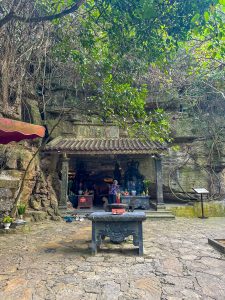
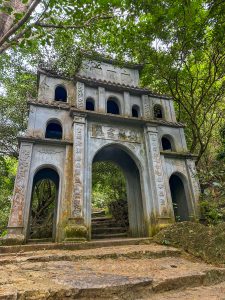
To understand the new, one must start at the Ancient Bai Dinh Pagoda nestled deep within the caves. This is where Saint Nguyen Minh Khong—National Zen Master of the Ly Dynasty and a master of medicine and alchemy—chose to practise 900 years ago. He did not just build a temple; he transformed this mountain into a healing sanctuary, gathering medicinal plants and using the sacred waters of the Pearl Well to heal the King and the people.
Ancient Vietnamese spirituality was often practised in the stillness and seclusion of caves. At the Light Cave, I felt the exceptionally high vibrations and the embrace of the Guardians. Deep in the Dark Cave, I met the Mother Goddesses and received an initiation into Đạo Mẫu. This indigenous belief honours the power of Mother Nature through the Mother Goddesses who govern Earth, Water, Heaven, and Forest—a deep connection to our roots and the life of all beings.
The new complex amplifies this ancestral energy, taking the essence from the shadows of the caves and radiating it to the world, asserting a national spiritual identity that is both powerful and profound.
Acupuncture for the Dragon Lines
Ninh Binh carries winding Dragon Lines, but history has also left scars of ancient suppression rites intended to bind the land’s life force. To dissolve these stagnant layers of energy, a corresponding weight is required.
Bai Dinh acts like a giant acupuncture needle. Bronze—the material of which Saint Nguyen Minh Khong is the patron saint—is a superb conductor of energy. Casting statues weighing hundreds of tonnes is a way to use “weight” to ground the site and the conductive nature of bronze to amplify the light of the Buddha, clearing energy channels that have been blocked for centuries.
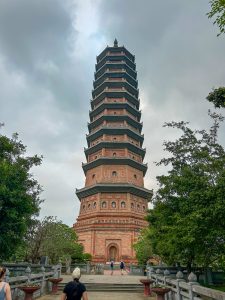
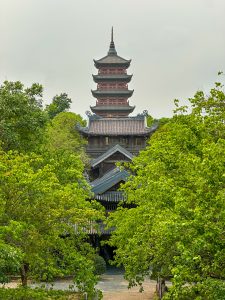
The placement of the Buddha’s relics atop the highest Stupa is more than a rite of worship; it establishes a spiritual ‘lighthouse’ to radiate light and peaceful frequencies, enveloping and transforming the energy of the entire region.
The Flower Sermon: A Silent Transmission
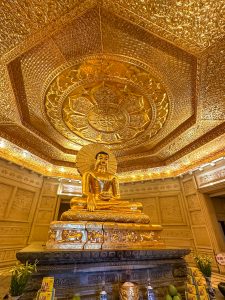
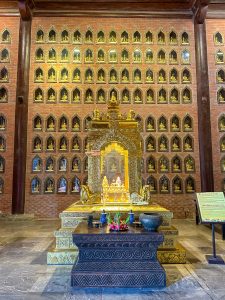
A standout feature is the 100-tonne Buddha statue at the The Shakyamuni Buddha Hall holding a lotus flower—the Niêm Hoa Vi Tiếu (The Flower Sermon) mudra. Legend has it that when the Buddha held up the flower on Vulture Peak, the assembly remained silent, save for Mahakasyapa, who smiled in understanding. This was the transmission of “Mind to Mind” (Tâm truyền Tâm). In that silence, their frequencies aligned perfectly; Mahakasyapa didn’t “learn” a lesson, he simply “attuned” to the Buddha state of consciousness within.
This symbol is usually found in small, secluded Zen temples. Placing such a subtle moment in a colossal statue is an intentional paradox: a reminder that no matter how grand the form, the core remains a silent understanding.
The presence of the relics of Mahakasyapa here serves as a vital link for the lineage of meditation from India to Vietnam, continuing the legacy of Saint Nguyen Minh Khong.
The Practice of Presence
I understand the aversion to the commercial pressure here — to maintain such a massive complex requires significant financial resources. But it is also a practice: can we look through the “business” layer to touch the energy within?
While standing before the Buddha relics atop the Stupa, my phone suddenly locked itself for 5 minutes. The Buddha wanted me to be fully present. While visiting the main halls and caves, I also felt within that I should not be taking photos or filming there.
Bai Dinh was built large for the world to notice, yet it holds within it symbols of stillness to lead us back to the most humble state. Do not come to Bai Dinh to see records; come to witness the medicine of the Master and the breath of the land being restored.
Discover more from Path of Miracles
Subscribe to get the latest posts sent to your email.